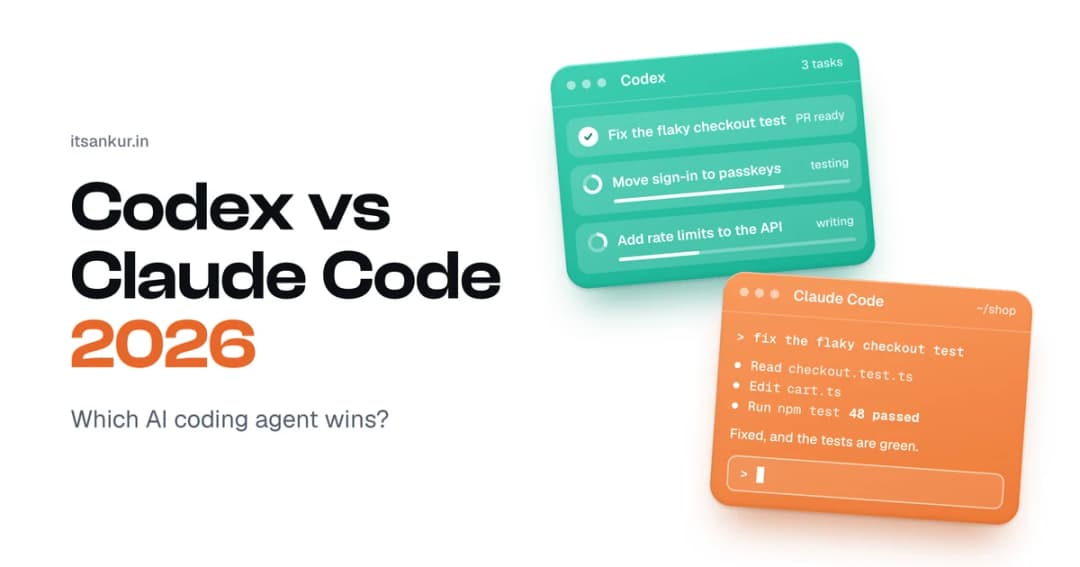
Codex vs Claude Code is the comparison most developers are running in 2026, and the honest answer is that both are excellent. The real difference is how you like to work. Codex is built around handing off tasks that run in the background, while Claude Code is built around working alongside you in your terminal and editor.
Both now cost the same at every main paid tier: $20 a month to start, then $100 or $200 for heavy use. So unless you need a free or $8 plan, price won't decide this for you. Workflow, model choice and usage limits will.
What is Claude Code?
Claude Code is Anthropic's AI coding agent. It runs in your terminal, in VS Code and JetBrains, in a desktop app and on the web. It reads your codebase, edits files, runs commands and tests, and works through multi-step tasks while you watch and approve.
Since Claude Code v2.1.280, every paid plan defaults to Claude Opus 5.5. You can switch to Sonnet 5.5, Haiku 4.5 or Fable 5.1 with the /model command (Claude Code docs). Its standout features are skills, hooks, subagents, plugins, MCP server support and a plan mode that proposes an approach before touching any code.
What is OpenAI Codex?
Codex is OpenAI's AI coding agent. It started as the open-source Codex CLI in April 2025, added cloud tasks in May 2025, and passed 2 million weekly active users by March 2026 (Wikipedia). It runs in the CLI, an IDE extension, the web, iOS and the ChatGPT desktop app, which absorbed the standalone Codex app on July 9, 2026.
Each cloud task runs in its own isolated sandbox, so you can queue several jobs and come back to finished pull requests. Codex now runs on OpenAI's GPT-6 models. GPT-6 Sol and Luna started rolling out on September 22, 2026, and GPT-6.1 Sol became the default a week later. Astra is the top model for hard problems, and Luna handles fast, cheap tasks (Codex models, changelog).
Codex vs Claude Code at a glance
| Claude Code | OpenAI Codex | |
|---|---|---|
| Maker | Anthropic | OpenAI |
| Core style | Interactive pair programmer | Background task delegation + interactive CLI |
| Where it runs | Terminal, VS Code, JetBrains, desktop, web | CLI, IDE extension, web, iOS, ChatGPT desktop app |
| Default model | Claude Opus 5.5 | GPT-6.1 Sol |
| Other models | Sonnet 5.5, Haiku 4.5, Fable 5.1 | GPT-6 Astra, GPT-6 Luna |
| Free access | No (API starter credits only) | Yes, Free and $8 Go plans (desktop app only) |
| Entry paid plan | Pro, $20/mo | Plus, $20/mo |
| Heavy-use plans | Max 5x $100, Max 20x $200 | Pro at $100, $200 or $500 |
| Open source | No | CLI is open source |
| Customisation | Skills, hooks, subagents, plugins, MCP | Plugins, MCP, custom model providers |
Figures as of October 2026.
Codex vs Claude Code: head-to-head
1. Workflow: pair programmer vs task delegator
This is the biggest difference, and it should drive your choice.
Claude Code is conversational and hands-on. You give it a goal, it proposes a plan, and it works through the steps in your local environment while you approve edits and commands. Plan mode (Shift+Tab) makes it lay out its approach before writing code, which helps you catch a wrong direction early.
Codex leans toward delegation. You describe a task, it spins up a sandboxed cloud environment, and it returns a diff or pull request. You can run several of these in parallel and review them later. Codex CLI also works interactively in your terminal, so you are not locked into the async style.
Winner: Claude Code for deep, interactive work on one problem. Codex for parallel, fire-and-forget tasks.
2. Models
Claude Code defaults to Claude Opus 5.5 on every paid plan. You can drop to Sonnet 5.5 for routine edits, use Haiku 4.5 for cheap subagent lookups, or step up to Fable 5.1 for the hardest problems. An opusplan mode plans with Opus and executes with Sonnet to save usage (Claude Code docs).
Codex defaults to GPT-6.1 Sol. GPT-6 Astra handles the hardest reasoning but uses credits five times as fast as Sol. GPT-6 Luna is very cheap and fast for simple tasks (Codex pricing).
Winner: Tie. Both give you a strong default, a premium tier and a budget tier. Codex has the cheaper budget model; Claude Code has finer-grained switching inside a session.
3. Customisation and integrations
Claude Code is the more customisable of the two. You can add skills (reusable instructions loaded on demand), hooks (scripts that run before or after actions), subagents (specialised helpers with their own context), plugins and MCP servers. A CLAUDE.md file gives it standing project instructions.
Codex supports plugins, connects to external MCP servers through codex mcp, and uses an AGENTS.md file for project instructions. Its CLI can also point at any compatible model provider through config.toml. Note that the codex mcp-server command, which exposed Codex itself as an MCP server, was removed on September 5, 2026 (Codex changelog).
Winner: Claude Code, especially for teams that want to encode their own workflows.
4. Codex vs Claude Code usage limits
Both $20 plans use five-hour windows, with weekly limits on top, and both can feel tight.
Codex: OpenAI publishes estimates. Plus allows roughly 15–160 GPT-6.1 Sol messages per five hours, 5–45 with Astra, or 350–3,000 with Luna. Pro plans currently have no five-hour limit, and weekly limits may also apply (Codex pricing).
Claude Code: Anthropic does not publish exact numbers. Each plan has a five-hour session limit and a weekly limit, shared with the Claude apps, and Max gives 5x or 20x the usage of Pro (Max plan). Scripted usage (Agent SDK, claude -p) draws from the same limits: a separate monthly credit for it was announced, then paused in June 2026 (Anthropic support). Because Opus 5.5 is now the default, switching to Sonnet 5.5 for routine work stretches your limits.
Winner: Codex, narrowly. OpenAI at least publishes message estimates for each model, though the ranges are wide: 15–160 is roughly a tenfold spread. Anthropic publishes no numbers.
5. Code quality and benchmarks
Benchmarks change every month and rarely match real projects. The most reliable test is your own codebase. Here's a simple way to compare them in an afternoon:
- Pick three tasks from your real backlog: a bug fix, a new feature that touches 3–5 files, and a refactor.
- Give both tools the same prompt for each task, starting from the same Git commit.
- Record four things: time to finish, number of follow-up prompts, whether your tests pass, and how much of your usage limit each one used.
- Review the diffs side by side. Look for unnecessary changes, missed edge cases and code you'd have to rewrite.
- Keep the tool that needed less fixing, not the one that finished fastest.
Winner: No clear winner. It depends on your codebase, so run this test before you pick one.
Codex vs Claude Code pricing
The two pricing ladders now match almost line for line.
| Tier | Claude Code | OpenAI Codex |
|---|---|---|
| Free | Not included | $0 (GPT-6 Luna in the desktop app) |
| Budget | — | Go, $8/mo (GPT-6 Luna in the desktop app) |
| Entry | Pro, $20/mo ($17/mo billed annually) | Plus, $20/mo |
| Heavy use | Max 5x, $100/mo | Pro, $100/mo |
| Heaviest | Max 20x, $200/mo | Pro, $200/mo or $500/mo |
| Team seat | $25/seat ($20 annual); Premium $125 ($100 annual) | Business, $25/user ($20 annual) |
| API, top model (per 1M tokens in/out) | Fable 5.1: $10 / $50 | GPT-6 Astra: $10 / $50 |
| API, default model | Opus 5.5: $4 / $20 | GPT-6.1 Sol: $2 / $10 |
| API, mid-tier | Sonnet 5.5: $2 / $10 | GPT-6 Sol: $2 / $10 |
| API, cheapest | Haiku 4.5: $1 / $5 | GPT-6 Luna: $0.10 / $0.50 |
Sources: Claude plans, Claude API pricing, Codex pricing and OpenAI API pricing, checked on 5 October 2026. Both companies changed plans several times in 2026, so check these pages again before you buy.
What this means in practice:
- On a tight budget: Codex wins. Its Free and $8 Go plans let you try it, while Claude Code needs at least $20/month or API credits.
- At $20/month: Even. Both cover a few focused sessions, not all-day use.
- For all-day use: Even at $100–$200. Anthropic's docs put average enterprise spend at about $13 per developer per active day, or $150–250 a month, at API rates. At $100 a month, Max 5x costs less than that for a full-time developer (Claude Code docs).
- For high-volume simple tasks via API: Codex wins thanks to GPT-6 Luna's very low price.
Which should you choose?
| If you are… | Pick | Why |
|---|---|---|
| A solo developer who codes in the terminal all day | Claude Code | Best interactive experience and customisation |
| Already paying for ChatGPT Plus | Codex | It's included; no extra subscription |
| Managing a backlog of small, independent tickets | Codex | Run several cloud tasks in parallel |
| Working on a large, complex codebase | Claude Code | Strong at long, multi-step refactors with plan mode and subagents |
| A student or hobbyist on a budget | Codex | Free and $8 tiers |
| A team that wants shared workflows | Claude Code | Skills, hooks and plugins can be shared across the team |
| Running agents in CI/CD | Either | Both run in CI with an API key at pay-per-token rates |
Alternatives to Codex and Claude Code
If neither fits, these are the main alternatives in 2026:
- Cursor – an AI-first code editor with a free Hobby plan and paid plans from $20/month. A good pick if you'd rather stay in an editor than work in the terminal.
- GitHub Copilot – the budget pick, with a free plan and Pro at $10/month. Its Pro+ ($39/month) and Max plans can hand tasks to Claude and Codex as agents inside Copilot, in preview (GitHub).
- Gemini CLI – Google's open-source terminal agent, the closest like-for-like alternative to Codex CLI and Claude Code (GitHub).
- Google Antigravity – Google's agentic IDE, built for managing several coding agents in parallel, and available at no charge (Google).
- OpenCode – an open-source terminal agent you can point at local models for near-zero cost.
Frequently asked questions
Is Codex better than Claude Code?
Neither is better for everyone. Claude Code is stronger for interactive, multi-step work and customisation. Codex is stronger for running many tasks in parallel and for users already on ChatGPT. Test both on your own codebase before committing.
Is Claude Code free?
No. Claude Code is not included on the free Claude plan. You need Pro ($20/month), Max, Team, Enterprise or API credits. Qualifying open-source maintainers can get six months of Max 20x free through Anthropic's Claude for Open Source program.
Is Codex free?
Yes, with limits. The ChatGPT Free plan includes Codex with GPT-6 Luna in the desktop app, subject to rollout. Codex in the CLI, IDE extension and on the web starts at Plus ($20/month), or you can use the CLI with an OpenAI API key.
Which is cheaper, Codex or Claude Code?
At $20, $100 and $200 per month, they cost the same. Codex is cheaper at the low end because of its Free and $8 Go plans, and its GPT-6 Luna model is far cheaper on the API than any Claude model.
Can I use Codex and Claude Code together?
Yes. Some developers use one to write code and the other to review it. Both work in the terminal and with Git, so switching between them on the same repo is straightforward.
What's the difference between Codex CLI and Claude Code?
Both are terminal agents. Codex CLI is open source and can be configured to use other model providers. Claude Code is closed source but offers deeper customisation through skills, hooks and subagents.
Which is better for beginners?
Codex is easier to try because of its free tier. Claude Code's plan mode is helpful for learning, since it explains its approach before making changes.
Final verdict
For most developers, Codex vs Claude Code is no longer a question of price, because the paid plans match. Price only matters at the low end, where Codex has a free plan and an $8 one. Beyond that, it's a question of workflow. Pick Claude Code if you want an interactive pair programmer you can shape to your team's way of working. Pick Codex if you want to delegate tasks in parallel and already live in ChatGPT.
The best move is to try both for a week on real work. Start with the $20 plan of each, track how often you hit limits and how many follow-up prompts each tool needs, and keep the one that ships more of your code.
Sources
Checked on 5 October 2026.
- Claude plans and pricing – Anthropic
- Claude API pricing – Anthropic
- Claude Code model configuration and costs – Anthropic
- Use the Claude Agent SDK with your Claude plan – Anthropic support
- Codex pricing, models and changelog – OpenAI
- OpenAI API pricing – OpenAI
- GitHub Copilot plans – GitHub
- OpenAI Codex (AI agent) – Wikipedia